


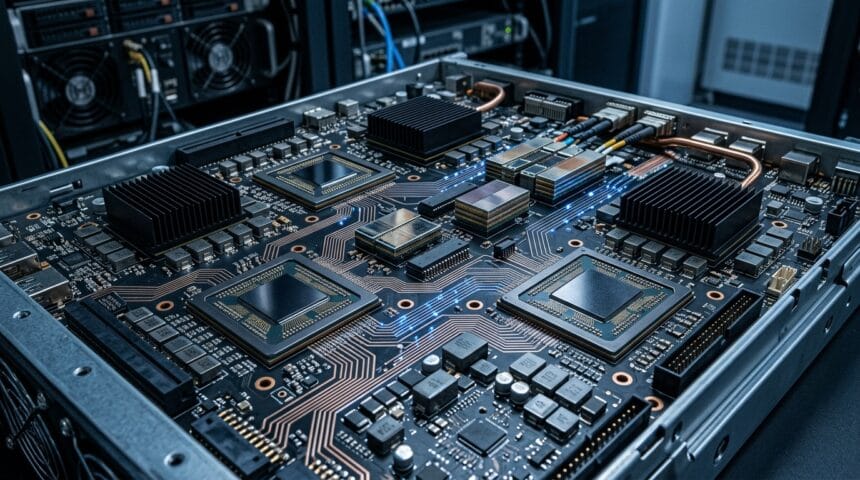
NVIDIA is investing $3.5 billion in MediaTek, deepening a semiconductor partnership that now stretches from PCs and cars all the way to the enormous data centers powering modern artificial intelligence.
But the investment is more interesting than the headline number suggests.
The two companies are expanding their collaboration around custom AI silicon, allowing MediaTek to build specialized chips that can connect directly into NVIDIA’s larger data-center architecture through NVLink Fusion.
That comes at an important moment for NVIDIA.
Some of the world’s largest technology companies are increasingly developing their own AI accelerators rather than relying exclusively on general-purpose NVIDIA GPUs.
Google has its TPUs. Amazon develops Trainium and Inferentia. Microsoft has invested in its own AI silicon, while major AI companies are also pursuing increasingly customized hardware strategies.
NVIDIA’s response appears to be broader than simply building faster GPUs.
If customers want custom chips, NVIDIA wants those chips to live inside an NVIDIA-centered computing ecosystem.
And MediaTek could become an important part of making that happen.
NVIDIA is putting $3.5 billion behind the partnership
The investment forms part of MediaTek’s $3.9 billion overseas convertible bond offering, according to Reuters.
NVIDIA is taking the overwhelming majority of that amount with its $3.5 billion investment.
Alphabet also participated in the offering, although MediaTek did not disclose the size of Google’s investment.
For MediaTek, the deal provides significant financial backing as it pushes beyond the consumer electronics markets where the company is best known.
MediaTek has long been a major supplier of chips for smartphones, TVs, connectivity devices and other consumer hardware.
Increasingly, however, it wants a larger role in data-center AI and custom ASICs.
The company describes its custom-silicon business as capable of building data-center chips optimized for performance, throughput, power efficiency and specialized AI workloads.
That puts MediaTek directly into one of the fastest-growing parts of the semiconductor industry.
For NVIDIA, funding that expansion creates another partner capable of extending its architecture into custom AI systems.
NVIDIA doesn’t necessarily need to manufacture every AI processor. It benefits if those processors still connect to an NVIDIA-centered computing platform.
The AI chip market is becoming more customized
For much of the generative AI boom, NVIDIA’s GPUs have been the industry’s most important computing resource.
Their advantage isn’t based on silicon alone.
NVIDIA has spent years building an ecosystem around its processors: CUDA software, networking technology, high-speed interconnects, rack-scale systems and increasingly complete AI infrastructure.
That ecosystem makes replacing NVIDIA considerably harder than simply designing another accelerator.
But hyperscalers have strong reasons to build their own chips.
Companies operating enormous AI workloads can optimize custom silicon around particular models, power requirements or data-center architectures.
At sufficient scale, even relatively small improvements in performance-per-watt or infrastructure cost can translate into enormous savings.
That doesn’t mean NVIDIA GPUs disappear.
Instead, AI infrastructure is becoming increasingly heterogeneous — combining GPUs, CPUs, networking processors and specialized accelerators inside the same data center.
That’s where NVLink Fusion becomes strategically important.
What is NVLink Fusion?
NVLink is NVIDIA’s high-speed interconnect technology for moving enormous amounts of data between processors inside AI computing systems.
With NVLink Fusion, NVIDIA has opened parts of that ecosystem so partners can integrate custom processors alongside NVIDIA technology.
MediaTek is among the companies adopting it.
Under the expanded partnership, MediaTek will use the NVLink Fusion ecosystem to help customers create custom AI infrastructure capable of integrating with NVIDIA’s rack-scale systems and what the companies call AI factories.
Think of the strategy this way:
A large cloud provider may decide that a particular workload doesn’t need another conventional GPU.
It may want its own accelerator instead.
MediaTek can help design that custom chip.
NVLink Fusion can then provide a path for that chip to communicate efficiently with NVIDIA-based infrastructure.
The customer gets custom silicon.
MediaTek gets a potentially lucrative data-center business.
And NVIDIA remains part of the architecture.
That’s why the deal matters beyond the $3.5 billion investment itself.
NVIDIA can benefit even when customers build their own chips
At first glance, the rise of custom AI accelerators looks like a direct threat to NVIDIA.
In some respects, it is.
Every workload shifted onto an internally developed accelerator is potentially a workload that doesn’t require an additional NVIDIA GPU.
But the AI data center contains much more than the accelerator running the model.
Processors need to communicate with each other. Memory must be moved rapidly. Servers need networking. Entire racks need to behave as coordinated computing systems.
NVIDIA has increasingly expanded into those surrounding layers.
Its strategy therefore has room for a world where not every processor carries an NVIDIA logo.
If custom chips still depend on NVIDIA networking, interconnects, software or rack architecture, the company can remain deeply embedded in the infrastructure.
MediaTek’s custom-silicon capabilities give NVIDIA another route into that market.
TechCrunch described the investment as part of NVIDIA’s effort to remain essential to AI infrastructure even as large customers increasingly pursue processors of their own.
That may become one of the defining semiconductor battles of the next several years.
The next AI chip war may not be about who builds every processor. It may be about who controls the architecture connecting them together.
MediaTek is moving far beyond smartphones
For consumers, MediaTek is still most closely associated with smartphone processors.
Its Dimensity chips compete across Android devices, while the company also supplies silicon for televisions, networking equipment, Chromebooks and numerous connected products.
But its ambitions now extend much further.
MediaTek says its custom ASIC operation targets data-center computing, AI, machine learning, networking and cloud-scale infrastructure.
The company has also been developing advanced high-speed interconnect technology designed for demanding AI workloads.
That transition isn’t happening from scratch.
MediaTek and NVIDIA already have experience building complex AI silicon together.
One of their most notable collaborations produced the GB10 Grace Blackwell Superchip, used in NVIDIA’s compact DGX Spark AI system.
MediaTek contributed expertise in areas including CPUs, memory subsystems and high-speed interfaces to the design.
The new investment significantly expands that relationship.
The partnership also reaches AI PCs
Data centers aren’t the only target.
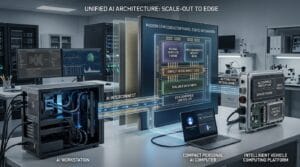
NVIDIA and MediaTek say they will continue collaborating across multiple generations of chips for local AI computing.
That includes the companies’ work around RTX Spark and DGX Spark-class systems, combining NVIDIA graphics and accelerated computing technology with MediaTek’s system-on-chip expertise.
Local AI has become another major front in the industry.
Instead of sending every request to enormous cloud models, PC manufacturers increasingly want systems capable of running inference directly on a user’s device.
That can reduce latency, improve privacy for certain workloads and lower dependence on cloud infrastructure.
It also creates another enormous market for processors capable of combining conventional computing with increasingly powerful AI acceleration.
MediaTek’s experience building highly integrated, power-efficient chips makes it an obvious partner for that kind of hardware.
Cars are the third part of the deal
The expanded collaboration reaches automotive computing as well.
MediaTek and NVIDIA already work together on Dimensity Auto, which integrates NVIDIA technology for AI-powered vehicle systems and graphics.
The companies now say that collaboration will continue across future generations of software-defined vehicles.
Modern cars increasingly resemble distributed computing platforms.
Infotainment, driver assistance, sensor processing, computer vision and eventually more advanced autonomous functions all require substantial processing power.
NVIDIA calls this broader shift toward AI systems interacting with the physical world physical AI.
MediaTek brings expertise in highly integrated system-on-chip designs.
NVIDIA brings GPUs, AI software and automotive computing infrastructure.
The investment therefore strengthens a relationship spanning three major computing markets simultaneously:
cloud AI, local AI and automotive AI.
The deal also raises questions about NVIDIA’s growing investments
There is another side to NVIDIA’s aggressive expansion.
The company has increasingly used its enormous financial strength to invest throughout the AI ecosystem.
That has attracted investor scrutiny over arrangements where NVIDIA financially supports companies that may, directly or indirectly, increase demand for NVIDIA technology.
Reuters notes that the MediaTek deal follows other large financial commitments connected to AI infrastructure, contributing to broader questions around so-called circular financing within the AI boom.
The MediaTek relationship is different from simply financing a customer so that customer can purchase more NVIDIA GPUs.
MediaTek is building products and technology that expand NVIDIA’s architecture into additional markets.
Jensen Huang rejected the suggestion that the arrangement is circular, telling Bloomberg that the companies operate their own businesses independently.
Still, the broader trend is worth watching.
NVIDIA isn’t only selling hardware into the AI boom anymore.
It is increasingly investing capital to help shape the ecosystem around that hardware.
NVIDIA is building around the possibility of a post-GPU AI market
None of this means GPUs are about to become obsolete.
Demand for NVIDIA’s data-center products remains enormous, and the company’s latest financial results continue to show extraordinary growth in AI infrastructure.
But NVIDIA appears to be preparing for a more complicated future.
AI computing may increasingly involve specialized accelerators built by hyperscalers, semiconductor partners and AI companies for particular workloads.
Instead of resisting that transition entirely, NVIDIA is creating ways for custom silicon to become part of its broader platform.
MediaTek’s role is particularly interesting because it already operates across consumer devices, custom ASICs, connectivity, PCs and automotive hardware.
Now it has $3.5 billion of NVIDIA backing behind an expansion into AI infrastructure.
The result could give both companies something valuable.
MediaTek gains a much larger path into the data center.
NVIDIA gains another way to remain at the center of AI computing — even when the chip doing some of the computing isn’t an NVIDIA GPU.