


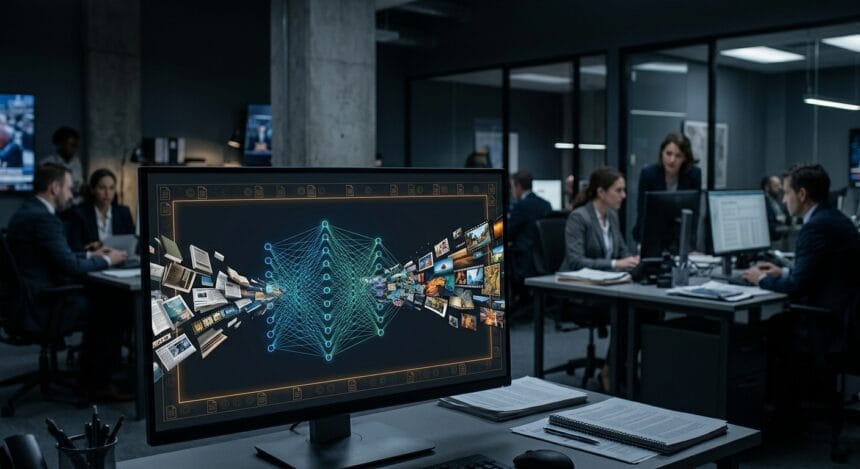
The United States is pushing one of the biggest unresolved questions in artificial intelligence onto the international stage: should AI companies be allowed to train their models on copyrighted work without negotiating a license for everything they use?
At a G20 technology gathering in North Carolina, U.S. Commerce Secretary Howard Lutnick urged participating countries to develop rules that allow copyrighted material to be used for AI training while still protecting the rights of creators.
The proposal arrives at a particularly consequential moment.
OpenAI, Anthropic, Google, Meta and other AI companies are already fighting lawsuits brought by authors, publishers, news organizations and other copyright holders over the material used to build their models.
And on the same day as the G20 push, the U.S. government stepped directly into one of the most important of those battles.
It backed OpenAI’s position in its copyright dispute with The New York Times.
Washington Wants AI Training to Have Legal Room to Operate
The U.S. isn’t asking countries simply to eliminate copyright protection.
Instead, Lutnick argued that governments need a framework capable of protecting creators without making large-scale AI development impractical.
The concept at the center of that argument is fair use.
Under U.S. copyright law, certain uses of copyrighted material can be lawful without explicit permission from the copyright holder. Whether AI training qualifies has become one of the defining legal questions of the generative AI era.
AI developers typically require enormous datasets containing text, images, code and other material.
Requiring a separate license for every piece of copyrighted material in those datasets could dramatically alter how frontier models are built — and potentially who can afford to build them.
The U.S. position presented at the G20 therefore favors maintaining enough legal flexibility for AI development to continue.
But Lutnick did not present a detailed international regulatory framework explaining precisely where that flexibility should end.

The U.S. Government Is Also Backing OpenAI
Washington’s G20 position isn’t occurring in isolation.
The U.S. government has also filed a statement supporting OpenAI in its long-running copyright dispute with The New York Times and other publishers.
The Times sued OpenAI and Microsoft in 2023, arguing that millions of copyrighted articles had been used without permission to help train the models behind ChatGPT.
OpenAI has argued that training its models constitutes fair use.
The government’s filing largely supports that legal theory, arguing that AI development has important implications for scientific progress, economic growth and American competitiveness.
That doesn’t mean OpenAI has won the case.
The government’s filing is not a court ruling, and the judge remains responsible for deciding the underlying copyright questions.
But federal intervention gives OpenAI’s position significantly more political weight.
The fight over AI training is no longer just a dispute between technology companies and copyright owners. It is becoming part of national technology policy.
The Central Question: Is AI Training Transformative?
Much of the legal argument revolves around what happens when an AI model learns from copyrighted material.
AI companies generally argue that models don’t function as conventional databases that simply store and redistribute every training document.
Instead, training adjusts billions of numerical parameters as the system learns statistical relationships and patterns from enormous quantities of data.
From that perspective, developers argue that the process is transformative.
Copyright owners see the situation differently.
Authors, publishers, artists and other creators have argued that companies are extracting commercial value from their work without obtaining permission or compensating the people who created it.
The disagreement becomes even more complicated when AI systems can generate output that resembles existing material or competes economically with the original creators.
That’s why the question cannot simply be reduced to:
“Did the AI copy something?”
Courts also have to consider how the material was obtained, what happened to it during training, what the resulting model produces and whether that use harms the market for the original work.

Previous AI Copyright Cases Have Already Produced a Complicated Picture
The legal landscape isn’t entirely blank.
Courts have already started addressing disputes over AI training, and the results show why simple claims that AI training is either clearly legal or clearly illegal can be misleading.
One closely watched case involved Anthropic and authors whose books were used in developing Claude.
A federal judge concluded in 2025 that using legally acquired books for AI training could qualify as transformative fair use.
But the court treated Anthropic’s acquisition and storage of pirated copies as a separate issue.
Anthropic later agreed to a $1.5 billion settlement with authors over the pirated-book component of the dispute.
That distinction could prove enormously important.
The legality of training on a work and the legality of obtaining that work are not necessarily the same question.
Other cases are still moving through courts, meaning the boundaries remain far from settled.
Creators Are Increasing the Pressure
Meanwhile, the list of plaintiffs challenging AI companies continues to grow.
Authors, news organizations, visual artists and music publishers have all brought cases involving generative AI.
Just days before the G20 discussion, the publishing arms of Sony Music and Warner Music sued Anthropic, alleging that copyrighted song compositions were improperly used in training Claude models.
Anthropic has said it will defend itself against those claims.
The music industry adds another layer of complexity because songs can involve multiple overlapping rights — including compositions, lyrics and recordings.
Similar disputes across journalism, books, photography and software mean the courts aren’t dealing with a single type of copyrighted material.
They’re slowly defining how an entire generation of AI systems can learn from human-created work.
The U.S. Wants Other Countries to Avoid Building Barriers Too Early
The copyright debate is also part of a broader American push at the G20.
U.S. officials have urged other countries to take a relatively light-touch approach toward artificial intelligence regulation and avoid imposing restrictions based primarily on hypothetical future harms.
The administration has promoted what it calls the Carolina Principles, emphasizing AI research, innovation and regulation focused on demonstrated problems rather than broad precautionary restrictions.
That puts the U.S. approach in tension with jurisdictions that favor stronger controls around AI development and deployment.
The stakes extend beyond copyright.
Rules governing data, model development, infrastructure, safety and intellectual property could influence where companies train their models — and which countries ultimately dominate the AI industry.

A Global Fair-Use Standard Would Be Extremely Difficult
There is another major obstacle to Washington’s proposal.
Fair use is fundamentally associated with U.S. copyright law.
Other countries have different copyright exceptions, licensing structures and legal traditions.
That makes creating anything resembling a universal G20 standard difficult.
A model developer might eventually face permissive training rules in one jurisdiction, mandatory licensing in another and additional transparency or opt-out requirements somewhere else.
For companies building models across global datasets and international infrastructure, that fragmentation could become expensive and technically complicated.
For creators, however, stronger national rules may provide leverage that a broad international exception would remove.
Neither side is arguing over a small technical detail.
The eventual rules could determine how trillions of pieces of human-created information are treated when they become raw material for artificial intelligence.
AI’s Copyright Battle Is Moving Beyond the Courts
For the past several years, AI copyright policy has largely been shaped through lawsuits.
That is beginning to change.
Governments are increasingly deciding that the question is too important to leave entirely to judges.
The U.S. intervention in the OpenAI case and its message to the G20 show Washington beginning to establish a clearer policy position: copyright rules should protect creators, but they should not make large-scale AI training impossible.
Creators and publishers are likely to push hard against any framework they believe gives technology companies unrestricted access to their work.
And courts still have many unresolved cases ahead of them.
The result will ultimately determine much more than whether OpenAI, Anthropic or Google wins a particular lawsuit.
It will help decide one of the fundamental economic rules of the AI era:
Who gets to learn from the world’s creative work — and who gets paid when they do?
Sources / Research Notes
The central G20 development comes from Reuters’ September 2 reporting on comments by U.S. Commerce Secretary Howard Lutnick. Reuters separately reported the U.S. government’s intervention supporting OpenAI in its dispute with The New York Times. TechCrunch independently reported on the government filing and its fair-use argument.
Reuters — U.S. urges G20 countries on AI training and creators’ work
Reuters — U.S. government backs OpenAI in New York Times copyright case
TechCrunch — U.S. government sides with OpenAI on AI training